Entrancing Entrances

How to declutter and create a welcoming entrance to your abode

When people first think about decluttering they automatically tend to think of the living room; the knick-knacks, newspapers, books, toys, mystery objects and paperwork left laying around. What people rarely mention is the hallway or entrance to their home. The entrance to your home is the first thing you see after a long, hard day, and the last thing you see after leaving. It makes an impression on everyone who walks through it, especially you.Therefore, your hallway or entrance should be one of the most welcoming places in the home, there to remind you that you will soon be able to put your feet up, be yourself, and spend time doing what matters. Walking into your home should be like a warm embrace, yet I’ve seen a lot of these spaces being used as open-storage for things which don’t otherwise have a place, or being overrun by eight coats and twenty pairs of shoes.

Hallways and entrances should only contain the things that you need for leaving home such as coats, shoes, hats and umbrellas. Of course, you can have decor which adds a vibe of your choosing- everyone has their own style. But there shouldn’t be an overabundance of clothing or objects.

Let’s talk about the issues with having too many coats and shoes. You and I both know, that such attire tends to take up a lot of space – so much, in fact, that when guests arrive, you just tell them to sling their coats over the stair post, or leave them draped on your dining chairs. Not to mention, each time you leave the front door you have to make a decision about what to wear, which takes precious time and energy.

Imagine walking into a spacious hallway with plenty of free coat hooks and space for guests to leave their shoes. The feeling of airy spaciousness and nothing for you to tidy when you walk through the door. Imagine being able to quickly made a decision about which coat and shoes to wear when you leave, no visual clutter stressing you out and no worrying about the impression on visitors. Relaxing, isn’t it?

So if you find yourself drowning in your hallway and rushing through it to escape the clutter,it’s time to take action. I realise that many people have issues with their families’ belongings when it comes to the decluttering process, but unless your significant other or family member is already on-board with the idea, just focus on your own stuff for now.

Firstly, take down all your coats and evaluate each of them. Ask yourself; how often do I wear this coat? Do I enjoy wearing it? Do I really need three different coats for a rainy day? If you struggle to get coats to match your outfits, the trick is to get a coat that is neutral and will go with most things you wear. It may even be worth checking your wardrobe for the clothes you wear the most (more about wardrobes and clothes in later posts).   

One of the best methods you can adopt when it comes to clothing is an ‘in with the new, out with the old’ philosophy. That way, when you buy a new pair of shoes or a new coat, you do so knowing that you intend to donate, sell, or trash the old one. Failure to follow that simple rule will ensure that you’re always drowning in decision making, tidying and searching. And nobody wants to live life like that.

Aside from coats and shoes, there’s another thing that tends to clutter up hallways and imbue a feeling of dread or procrastination  -paperwork and unopened mail. I’m not talking about the mail that simply lands on your mat as it comes through the letterbox, but the mail that is left to pile up in the next available space. Some people leave it lying around on hallway consoles and on window ledges so it is bugging them as they leave for work and greeting them with a ‘to do’ list as soon as they re-enter the home. My recommendation for mail, is to have a specific drawer, cupboard or folder where everything can be effortlessly accessed at a moments notice. “But I need a reminder to pay my bills”, you say. In that case, I recommend using a calendar, either physical or digital. Personally, I use a physical diary, preferring to cut down on the digital cacophony that has become part of modern life.  Everyone’s methods will be slightly different.

Lastly,  don’t leave kids toys, rogue bags, receipts or any other miscellaneous items hanging around your entrance. If anything is out of place, put it back where it belongs immediately, preferably before you even leave your home. That way, you know you’re leaving the place exactly as you want to return to it (unless, of course, you have messy family members, in which case, further posts about living with other people’s clutter might be for you).

But what about creating a relaxing vibe that you’ll always be happy to walk into? If you’re worried about things looking too sparse or are worried about other issues such as lighting, there are several things you can do:
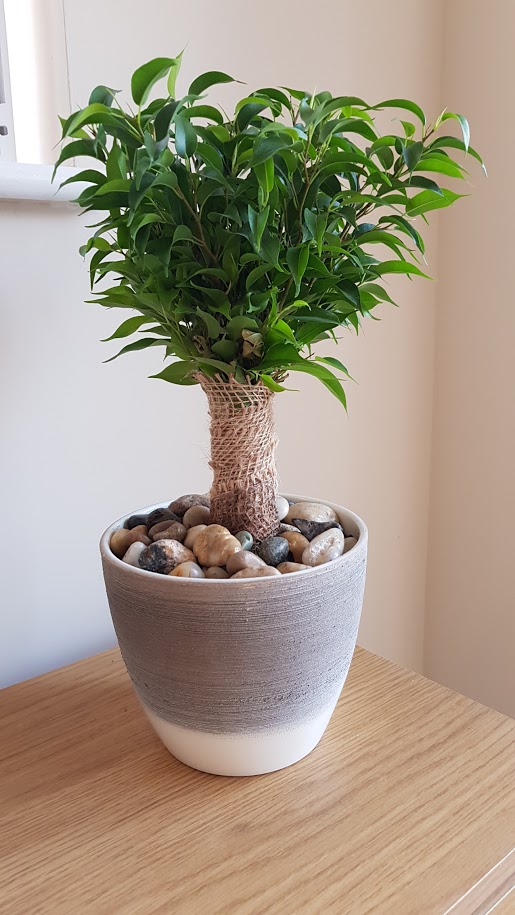
You can’t go wrong with some healthy, homely greenery
  • Plants and greenery do wonders to spruce up any room, and having one or two in your hallway can make the environment feel fresh and airy.  You can also use a diffuser to ensure you are constantly greeted by a pleasant aroma of your choice, although you’ll want to keep them in a spot where they won’t get knocked over or explored by tiny hands.
  • Personalise with photos of friends and family, or give the walls some character with a few select pieces of art – don’t go overboard with this, however, as too much can make a room feel cluttered.
  • Furniture doesn’t have to be boring – for example, you can buy stylish and decorative umbrella stands for a very affordable price. Having an umbrella stand will also take away the temptation for people to leave wet umbrellas draining over the floor.
  • Think about lighting – a hallway struggling for light may benefit from a strategically placed mirror. Mirrors can also help make narrow spaces look a little wider. Failing that, a beautiful or stylish lamp can make a big difference. In my own home, we had the living room and kitchen doors replaced with glass panelled ones so that the light from those rooms would filter through.

The most important thing, however, is to treat the entrance to your home with love and respect. Doing so can and will make a big difference to your mood and your attitude to the rest of the house.

Next, I will be talking about how to declutter your living room and make the perfect respite for you and your guests.

If you have any questions or if there’s something I haven’t covered, feel free to leave a comment.

Things You Must Know About Decluttering

Over the years there are many lessons I have learnt when it comes to decluttering, and it is these lessons I will share with you before going into decluttering specific rooms and furniture.  Without these small nuggets of wisdom, it is easy to lose motivation or even hamper your attempts to live a clutter-free life.

 Firstly, it’s counter-productive to buy more storage. Once-upon-a-time, whenever I ran out of storage space I would either buy one of those plastic under-the-bed boxes, or I would buy larger pieces of furniture.  At the time I didn’t realise that all that was doing was encouraging me to keep stuff that no longer served me. I was organising and re-organising my clutter again and again, whilst telling myself that more storage was the answer. It isn’t.

 Secondly, clutter is something that you need to keep on top of every single day, because clutter accumulates over the years as our tastes change, as Christmases, birthdays and other celebrations fly by, and as paperwork comes into the home. Once you become complacent and allow the odd piece of paperwork or the occasional old t-shirt to remain in storage, before you know it, the paperwork has become a mountain of overwhelm and the clothes are back overflowing the drawers.  You’re back living in Clutterville and all your hard work feels completely meaningless. I’ve watched people despair that they had an all-day tidying session, only for it to look ‘as if a tornado passed through the house’ days later.  To truly be in control of your environment, not only must you be mindful of what goes into your shopping bags and what you already own, you must continue to be in tune with your emotions, and the tendency to hold on to your possessions. As I discussed in my previous post, it is of utmost importance that you understand the relationship between you and your stuff.

Thirdly, it does get easier. The more you declutter, and the more of your true-self that emerges, the easier it will become to discern between what’s important to you and what can go to be loved by somebody else.

So how exactly does one go about decluttering so many years of stuff? You start off small, and with what is immediately in your line of sight.

For example; if you’re more like I was, and drawers and cupboards are hiding the mess, then start off by emptying one. Just one. By setting yourself that one small challenge to begin with, you’re much less likely to become overwhelmed and give up. Tasks are much more do-able and easier to stick to when they are chunked. However, if you feel the motivation to keep going, then definitely do so! Just focus on one small part of the room or on one piece of storage at a time.

If surfaces are an issue for you and are crowded with years old trinkets that have gone through many themes of decor in your home, it can feel almost impossible to get started. In that case you need to ask yourself some serious questions: How many of them do you really need? Do they add anything of value, or do they make you feel stressed and uncomfortable? Do they have memories attached? Were they just on sale at the time? Were they an unwanted gift? Go through each item and feel for which ones truly make you happy to display.

As you get into a flow of decluttering, you’ll naturally start to notice other objects that completely eluded your attention in the past. Perhaps you’ll discover handfuls of ballpoint pens and several pads of unused paper – I did. And what about those old books? Should you donate the ones you know you will never touch again so that somebody else may enjoy them? Why have you still got that old chipped mug?

With all this in mind, please remember that you don’t have to get rid of everything all in one go, even if you are just working on a small corner. If getting rid of one object a day is all you can manage to begin with, then go with that. Any progress is better than no progress at all. For many people, the path to minimalism is a challenge because of the deeply ingrained beliefs that come from marketers, a consumerist society, sentimentality, and guilt. If you struggle with letting go, it is a lengthy and emotional journey, and it is important to tackle large projects with a calm mind, in bite-size chunks.

Persist in the journey towards minimalism,and you will find that the long-term rewards will far outweigh the allure of material objects.

My upcoming content will be a series of ‘how to’ posts to declutter specific rooms, starting from when you enter your front door. Stay tuned for my next post about hallways and entrances.

So Much More Than Stuff – Finding Your Why Amidst The Clutter

Before we get into the details and all the nitty-gritty of decluttering, I want you to know that the process can seem very difficult at first. If you’ve been reading my posts up to this point, you’ve probably acknowledged that you have too much stuff, and maybe you can’t wait to get started – if so, that’s great – but know that at some point you’re likely to meet a wall of resistance and feel overwhelmed. Minimalism is a lifestyle choice, and it’s not just your clutter that you will be dealing with, but your whole mindset.

Once you feel the journey becoming difficult ,don’t despair. It will get easier, and it’s completely natural to experience those feelings. We’ve spent our whole lives being convinced by companies and advertisers that we need more,bigger, better, newer and shinier to be happy, when what we really crave, are satisfying moments, relationships, careers, and experiences. Most of society is sold on the idea of happiness and success being a bigger house and a posher car…all in the pursuit of storing and acquiring even more stuff. When does it stop?

It doesn’t.

Many years ago, I saw a TV program (that I can’t remember the name of) which was showing the lives of people who were rich enough to afford gold-encrusted toilets and gold-flecked perfumes. Some had priceless works of art. The kicker? Most of these people were more miserable than some of the poorest people I know.

As long as your belief remains grounded in material objects being the key to satisfaction, the mission won’t ever end. It’s like eating a slice of gooey chocolate cake: you’re satisfied for all of half an hour and then the lingering aftertaste has gone and you want more. There will always be a bigger house, a smarter phone, a better gadget, a shinier car, a new craze, a newer fashion trend, and a sale on ‘must have’ items. Always.

Let’s admit it, keeping up with all that is not only a permanent leak in the wallet, but exhausting to keep up with, which ultimately leads to feelings of emptiness and intense dissatisfaction in the long-run. Sometimes, it can even cause feelings of guilt which leads to you desperately trying to justify your latest purchases to others – I’ve been there. Chasing happiness through material goods is a vicious circle. A never-ending sprint up a backwards escalator. You see, happiness doesn’t start with what’s in your wardrobe, but what’s inside you.

S

Because our possessions are so often entrenched in our emotions and core beliefs, before you start the decluttering process, I want you to clear your mind and think about your buying habits and the items you already own. What caused you to hold onto all your stuff in the first place? If you find yourself always buying more stuff, think about what it is and why? Do you really need it? How does it make you feel afterwards? And the most important question of all: Why do you want to change? I recommend writing it all down and letting your mind go as free as a butterfly. Nobody has to see it but you. Your ‘why’ is so important to understand in anything that you choose to pursue in life because without it, there’s no strong motivation and you will find yourself giving up before you’ve even started.

In upcoming posts I will finally get down to talking about the decluttering process itself, and you will learn how to let go, as well as how to cope with sentimental objects, and how to live with someone else’s clutter. I’ve been there, so I will be with you all the way.

Minimalism is about YOU!

If it’s the first time you’ve heard about minimalism, you’re probably feeling a little overwhelmed. If you’re anything like I was, the term, minimalism, might conjure images of empty rooms with surgically clean white walls and a single chair. You wouldn’t be wrong, but you might be surprised to learn that you can still be a minimalist whilst keeping all the things that you treasure. First of all, let me tell you what minimalism is and isn’t.

Minimalism isn’t about purging everything you own and love. Nor is it about white clothes, white walls and white furniture. Minimalism is about only keeping the objects which are important and meaningful to you. It’s about creating space and discovering who you really are beneath the clutter. It’s about prioritizing your life and making the most out of moments rather than things. It’s about you.

In the coming days I will be telling you my personal story of how I went from hoarding to minimalism, and, most importantly, what caused me to hoard in the first place.